

Testosterone has a MENOAMAZING Problem
A new study of testosterone and hip fractures: Social media hype vs. reality

MENOAMAZING™: The Art of Turning Weak Data Into Menopause Miracles.
Sadly, this seems to apply to a lot of content about both estrogen and testosterone, because it feels as if I am regularly sent articles that are promoted on social media as AMAZING evidence of their magical powers, but when I take a closer look, these articles and the claims on social media don’t hold up. And this is very problematic, because many of these papers are waved around in videos on Instagram and TikTok as if they are a veritable menopause Rosetta Stone, containing the magical key to being fracture-free, heart-attack-free, dementia-free, wrinkle-free, as well as the secret to longevity. You know, the basic fountain of youth.
The truth is, medical research varies significantly in its relevance to patient care, and it’s rare that a single study changes things, because the scientific method builds on a body of knowledge. While a well-designed clinical trial is usually worth discussing, those of us interested in science communication must be very careful with context and explain how any study fits with what we know. We must be especially mindful of how we discuss retrospective and database studies in menopause. One, because this is what we call observational data, which can only tell us about correlation, not causation, so it doesn’t help us much when it comes to tying outcomes to a medication. Unfortunately, many times I see these observational studies spoken about in such a way that could lead the audience to mistake the work as a clinical trial. And two, because women with more money and/or those who are healthier are more likely to have access to hormone therapy, this means in observational studies, the women taking hormones are primed to have a better outcome, which could be mistaken as a benefit of the hormone therapy.
An unfortunate example of this hype machine occurred a few months ago regarding an abstract presented at the Menopause Society meeting in October. This was a database study that, at best, is of use to researchers in designing future studies and should have no role in patient care (I wrote about it here). Then again, being amazing, and ground-breaking, even when that is not the case, is what gets attention on social media, not accurate discussions about database studies and their limitations.
In addition, there are papers that have serious methodological flaws, and one wonders how they were published in the first place. (Sadly, an open secret in science is that the only reason a paper hasn’t been published is that the lead author has not hit “send” enough times.) And so, before we, as health communicators, discuss a study publicly, we should assess both its relevance to the field and its quality. And with that, I bring you the study on testosterone therapy and hip fractures I will discuss, which was sent to me the other day.
The study is titled “A Matched Retrospective Analysis: The Relationship Between Testosterone Replacement Therapy and the Incidence of Hip Fractures,” and is published in the Journal of the American Academy of Orthopedic Surgeons. I would have rejected it had I been a reviewer. I cannot understand how someone could read this article and think it is worth discussing with the public.
The Purpose of the Study
To explore the relationship between testosterone therapy and hip fractures…for women AND men. And given the numbers, mostly men (about 25% of participants were women). Yes, this is a study about hip fractures that includes women and men, and a lot of the data was lumped together, as if women and men have the same biology when it comes to bone health, fracture risk, and prescribing testosterone. I had to go to the supplement (leave the main paper for an appendix in another document) to find out how many women were included.
If anyone who promoted this article has also complained about women not being studied separately from men…well, oh, the hypocrisy. The investigators should have separated the results into two papers; it is absurd to consider women and men together when it comes to hip fracture and/or use of testosterone.
Le grand sigh.
The Methods
The researchers used something called the PearlDiver Mariner165 Database to find men and women who had been prescribed testosterone therapy for at least three months and control groups who were matched by age, sex, smoking, and a few other variables that were available in the database. They then looked at the rate of hip fracture over 2 years.
This is an administrative claims database that captures billing codes for procedures, diagnoses, and dispensed medications submitted to insurance companies (including Medicaid and Medicare). It has the usual billing code database issue: the researchers depend on everyone entering the billing codes correctly, so they may over record or under record diagnoses and confounders. Billing code databases are useful for scanning large numbers of people to look for signals; they are not useful for drawing conclusions.
What is especially relevant here is that the PearlDiver database has no demographic data, which is problematic because based on what we know from other research, it is very likely those women who received testosterone were different demographically from those who did not, as women who are healthier and wealthier are far more likely to be prescribed testosterone therapy. This is a major confounder that this database could easily miss or underestimate.
There are some other serious issues. One is a fatal flaw, and others are severe limitations of the database:
The fatal flaw: The authors did not control for estrogen use. No, really. Most women who take testosterone are likely also taking estrogen, and as estrogen is associated with a lower risk of hip fractures, it’s nothing short of shocking that it wasn’t included. If the authors could pull the testosterone prescriptions, they could have pulled the estrogen prescriptions. This alone makes the data unusable if you are trying to isolate the impact of testosterone; it must be separated from the known positive impact of estrogen. For this reason alone, I would have rejected the study. Why did they not include estrogen prescriptions? They did not say.
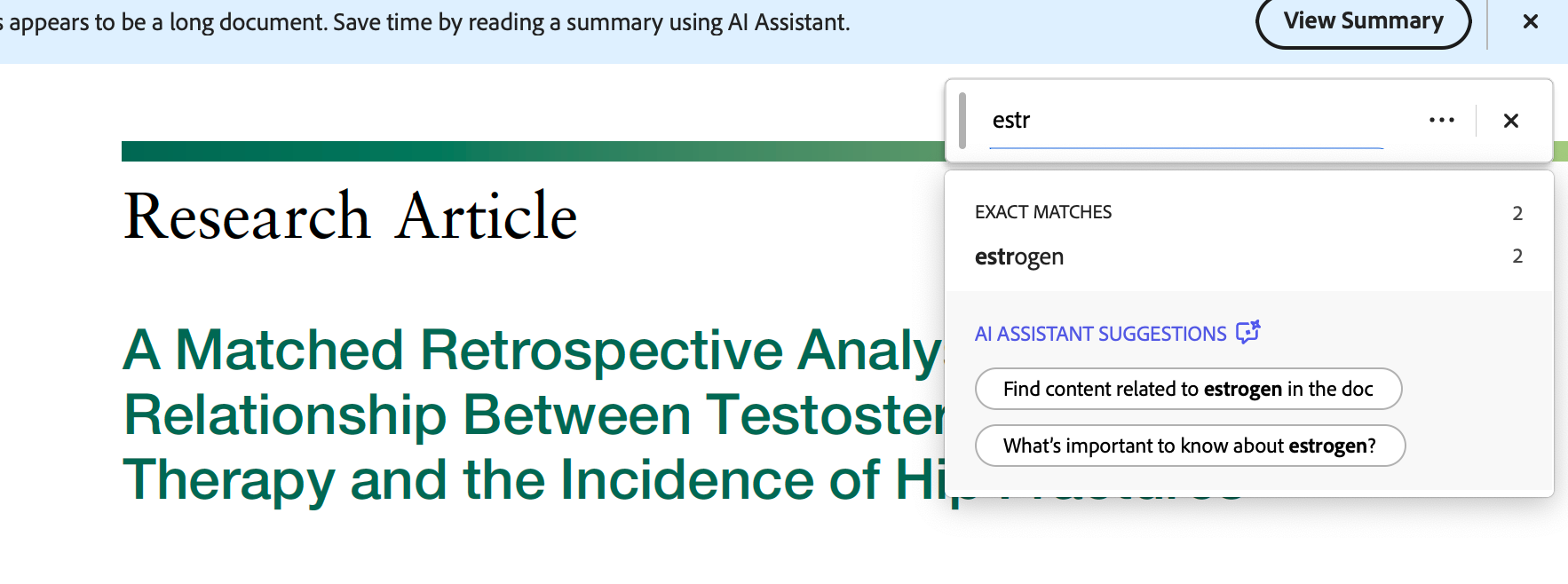
The decision to ignore estrogen was a big, what the f*ck, for me. To make sure I hadn’t missed something (because, really, this is astounding!) after reading the paper several times, I did a word search for words beginning with estr- (as that would catch estradiol, conjugated equine estrogens, and estrogen). Only estrogen is mentioned, twice, and that is in the discussion, where the authors acknowledge the role of estrogen in bone health.
Other issues are database-related, and illustrate why we can’t imply cause and effect or draw conclusions from this paper:
The data on testosterone is almost certainly incomplete. Many women get testosterone therapy in the form of pellets or from concierge practices outside of their insurance, so this testosterone use will be completely missed by the database.
They did not control for the age of menopause. This is not available in the database.
There is no information on the testosterone dose.
There are no testosterone levels.
The investigators controlled for osteoporosis, but this was based on billing codes rather than DEXA scan results. Studies examining the accuracy of billing codes show that they miss a substantial proportion of patients with true osteoporosis while incorrectly identifying many patients without osteoporosis.
There is no information on activity levels. It is highly possible, and probably likely, that the women who used testosterone were overall healthier and more physically active than those who did not. People who are more physically active tend to have more muscle mass, which is protective against osteoporosis and falls, a major cause of hip fractures.
The Results
Honestly, it doesn’t really matter given the lack of estrogen, but we’re here!
There were 301,724 matched pairs, meaning 301,724 testosterone-users and 301,724 non-users. There were 76,610 matched pairs of women: 76,610 taking testosterone and 76,610 not taking testosterone. The authors reported about a 50% reduction in hip fractures overall among women taking testosterone versus those not taking it. It sounds impressive, and I am sure that number was flashed on social media as breaking news, but it’s not a reliable number given all the limitations of the study and the database.
The paper divides women into four age groups: 35-45, 45-55, 56-65, and 66-75 years. There was no difference in hip fractures between the 35-45 and 45-55 year age groups, although the absolute numbers of hip fractures over 2 years were very low in these age groups, limiting analysis. Let’s confine ourselves to the 55-65 years and 66-75 years age groups. This includes a total 43,252 women who used testosterone and 43,252 controls. The results suggest a 51% reduction in hip fractures for women taking testosterone who are 56-65 years, and a 31% reduction for those ages 66-75 years.
These numbers seemed awfully high to me for 2 years or less of testosterone, so I pulled the WHI for comparison. The reduction in hip fractures with five years of estrogen and progesterone was 33%. I just do not believe that two years or less of an unknown dose of testosterone is as effective or more effective than five years of estrogen in preventing fractures. Extraordinary claims require extraordinary evidence, which is lacking here. (I’m always happy to be proven wrong with a quality clinical trial.)
I also wanted to compare the fracture rate in the control group in this new paper with that of the placebo group in the WHI, which were women of average health. Among the control group in this new study, 195 of the 43,252 women aged 55-75 years had a hip fracture over 2 years, and if I did my math right, that means the rate of hip fracture rate was 22.5 per 10,000 women per year. The rate of hip fracture among the placebo group in the WHI was 16 per 10,000 women per year. This means the control group in the database study had just over 40% higher annual rate of hip fracture when compared to the placebo in the WHI, which could support the hypothesis that women who did not get a testosterone prescription had a higher baseline risk of hip fracture.
Can We Take Anything Away from this Study?
No.
As I noted earlier, this study has a fatal flaw: it fails to consider estrogen use, and it would be logical to assume that the majority of women taking testosterone were also taking estrogen. In addition, the PearDriver database lacks important demographic data, which, even if we had estrogen data, would severely limit any conclusions. In any study like this, I would always expect the hormone therapy group to have better outcomes, as they are likely to be wealthier and have access to hormones, and people who are in poorer health may not be candidates for health reasons.
It is true that there are some studies showing that after menopause, higher levels of testosterone are associated with a decreased rate of fracture, but higher testosterone levels do not mean that testosterone therapy will be effective for bone health. Are testosterone levels higher because women are healthier, or are the higher levels helping bone health? We can’t say without a placebo-controlled trial. There are some small clinical trials looking at testosterone and bone density, but the results are conflicting. The 2019 systematic review and meta-analysis of testosterone therapy that included 36 randomized controlled trials comprising 8,480 participants found insufficient data to draw conclusions about testosterone’s effects on bone health. And this new study is of too low quality to contribute to the discussion in any meaningful way. We are at the point where a clinical trial is needed to say anything valuable about testosterone and bone health.
PearlDiver is valuable for analyzing healthcare utilization patterns and identifying trends, it has no value for clinical care. Pre-social media, this kind of nothing-burger study would get published, and no one would hear about it other than the research community, who may find it useful to consider when designing other observational studies or clinical trials. But then came the internet, social media, and meno-influencers and now there are hundreds of thousands of eyeballs, sometimes millions, directed towards research that just isn’t ready for prime time, but hyped like it is.
Often when I write a post about an article like this, I’m accused of being too negative, but I’m just being accurate. It would be nice if people didn’t promote papers like this; but when they do, I feel it’s important to give people the full picture. I want to point out that I also review studies that I think are worthy of sharing because they may change clinical care or they add significantly to the body of knowledge. I’d like to highlight a couple of those posts.
This post on the randomized trial looking at partner treatment for bacterial vaginosis.
And this post, and this one from just a month ago, both looking at the shingles vaccine and dementia risk. The data discussed in these posts comes from database studies, so they can be useful. But even here, I’m always cautious about pointing out that the data is observational, because facts matter.
It’s simply wrong to suggest to any woman that this database study looking at testosterone prescriptions and hip fractures should be used as evidence to support the use of testosterone for bone health, and I’m sick of low-quality studies being dressed up as evidence and presented as life-changing menopause science for click-bait.
Women deserve better.
References
Peresuh SJ, Arcand PH, Confessore J, Parvaresh-Rizi A, Testa EJ, Quinn M, Avellino G, Arcand MA, Daniels AH. A Matched Retrospective Analysis: The Relationship Between Testosterone Replacement Therapy and the Incidence of Hip Fractures. J Am Acad Orthop Surg. 2026 Feb 1;34(3):e370-e375. doi: 10.5435/JAAOS-D-24-01334. Epub 2025 Jul 3. PMID: 40627853.
Cauley JA, Robbins J, Chen Z, et al. Effects of Estrogen Plus Progestin on Risk of Fracture and Bone Mineral Density: The Women’s Health Initiative Randomized Trial. JAMA. 2003;290(13):1729–1738. doi:10.1001/jama.290.13.1729
Islam RM, Bell RJ, Green S, Page MJ, Davis SR. Safety and Efficacy of Testosterone for Women: A Systematic Review and Meta-Analysis of Randomised Controlled Trial Data. The Lancet Diabetes & Endocrinology. 2019;7(10):754-766.
We are in the darkest of times, the US is being led by politicians and by billionaires who reflect the very worst of humanity—thank you for being a bright light, not only in and for women’s health but by modeling critical thinking (with humor!) and truth-telling again and again. You are a strong reminder of the best of humanity.
Thank you again! I can't believe the flaws in this paper - I won't call it a "study". It is exhausting to battle this every day in clinic in addition to what is happening in the world around us. Thanks for being a voice of reason on both fronts!