

DOJ-Released Files Include Emails Between Dr. Peter Attia and Jeffrey Epstein
A Closer Look at the Correspondence and some Lessons about Longevity

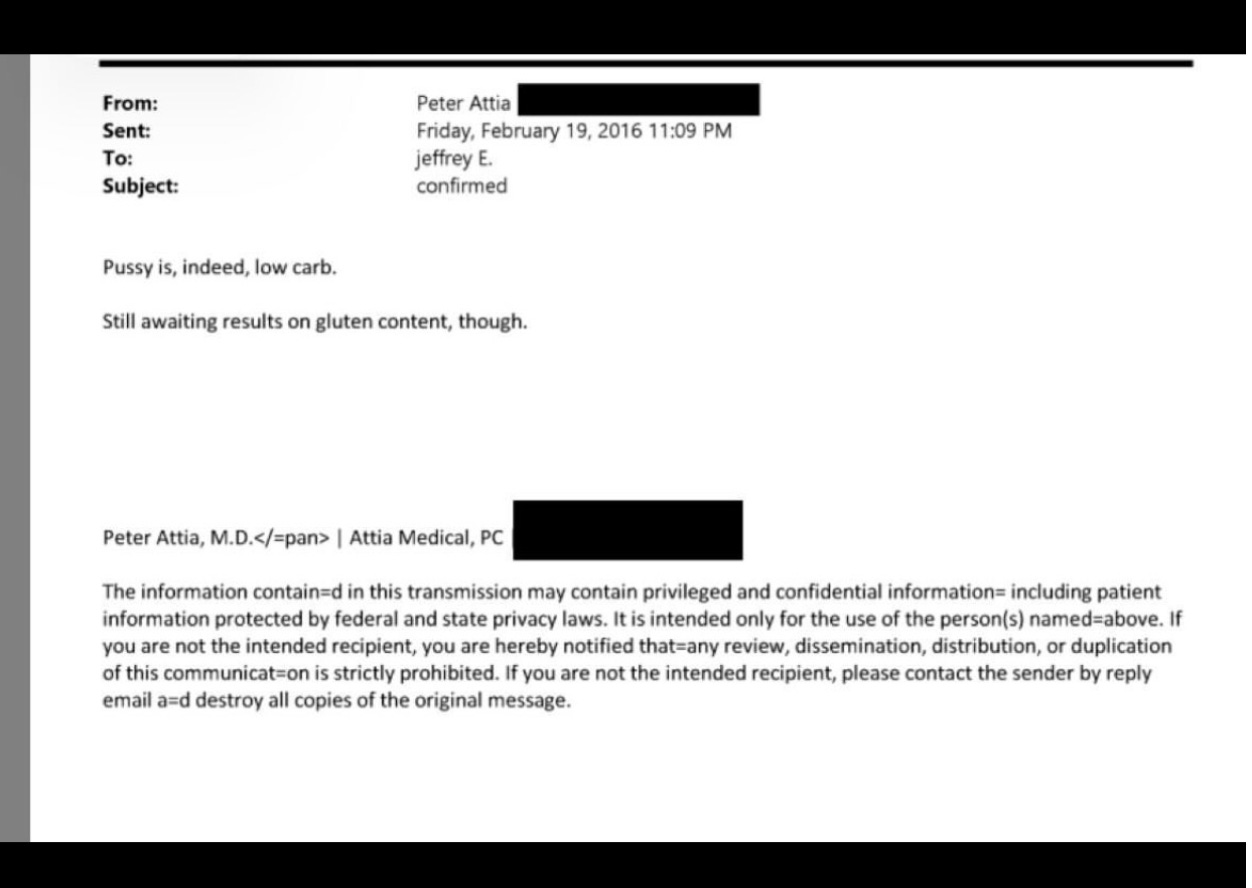
The DOJ just released a new stash of Epstein files. There are multiple emails between Dr. Peter Attia and Jeffrey Epstein discussing medical matters, travel, and other things, such as “Pussy is, indeed, low carb.”
Before we go any further, numerous people have asked if this is real. These are official government records, and so I am reporting on them as such. Here is the link to the Epstein files from the Department of Justice for anyone who is interested in searching for themselves. Attia’s connection to Epstein was initially reported by CBS News late last year (2025), which is interesting, as CBS just hired Attia as a contributor. Maybe Bari Weiss, editor-in-chief at CBS News, needs to actually read CBS News? Then again, her wife is in the Epstein files, so who knows if this kind of thing matters to the rich and powerful.
A reasonable reader would conclude that the Peter Attia referenced in the emails refers to the Peter Attia MD who told 60 Minutes that he charges over $100,000 a year for his concierge practice, and who is a podcaster, a self-proclaimed longevity expert, and who wrote the book Outlive.
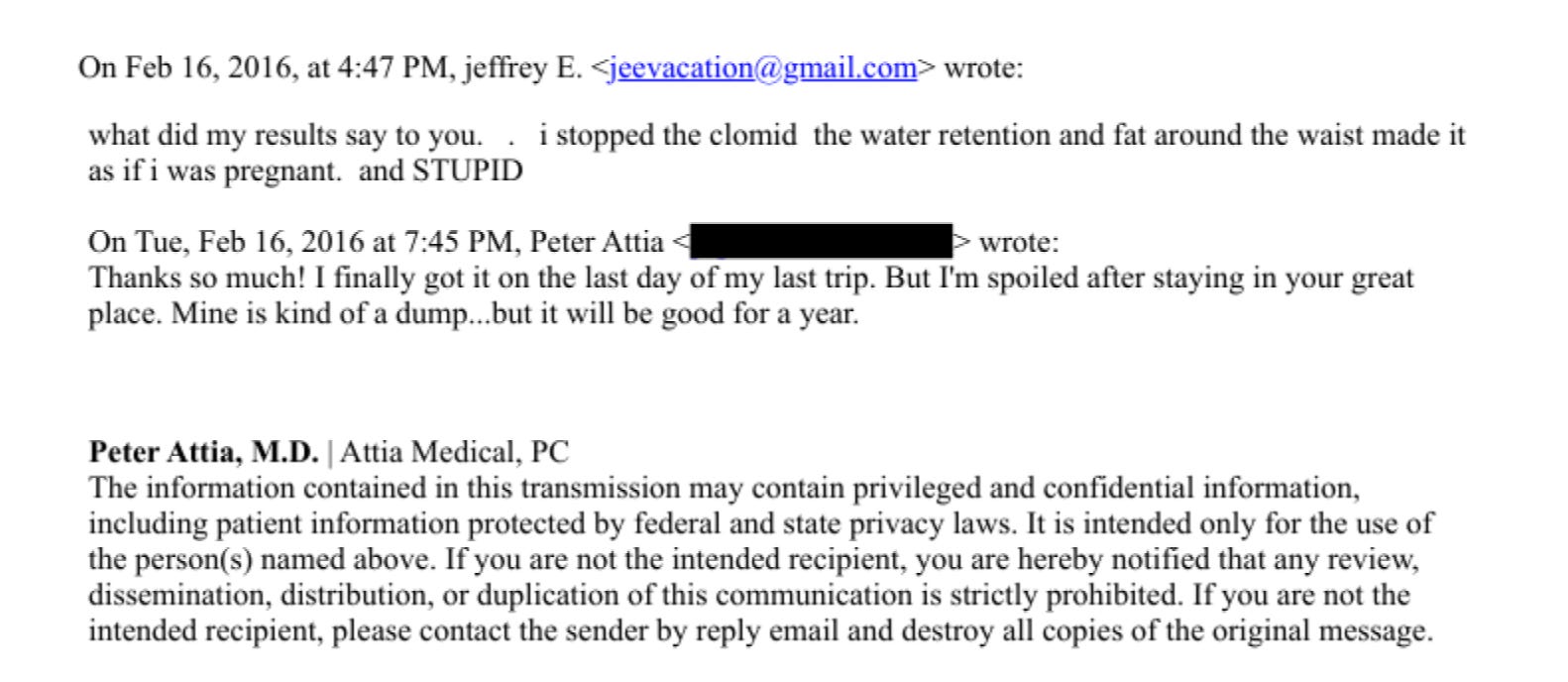
(The great place in question appears to be an apartment in New York, which I pieced together from reading other emails.)
Many of the emails detail mundane medical conversations, such as Neurontin for back pain, statins, MRIs, visits to a specialist to discuss what sounds like a nerve block for back pain, and Clomid. (I have only prescribed Clomid for women, but it is used for men to boost testosterone and sperm production, according to two colleagues who do prescribe it). CBS News reported last year on in person appointments between Attia and Epstein in Epstein’s calendar, and “The schedule includes notations for blood draws and follow-ups over several years.” But we can’t know from the DOJ emails or from the CBS report the true nature of the relationship; was Attia acting as Epstein’s doctor or was he operating in some kind of non prescribing advisory position? Unknown.
If these emails were just about the dose of Neurontin for back pain or when to get an MRI, I don’t think I would be writing about them. Everyone deserves a physician, even people who were convicted and jailed for coercing a minor into prostitution. Although, I suppose it would be worth noting that nothing I read (and I have not read all the emails), offers any secret to longevity or how to outlive anyone. It does make me wonder what one gets for $100,000 a year?
What is deserving of attention is emails in the DOJ files that discuss matters that do not appear to be related to medical care. Some content, such as: “Pussy is, indeed, low carb,” is disturbing and well outside anything most physicians would consider appropriate to email someone required to register as a sex offender because they had coerced a minor into prostitution.
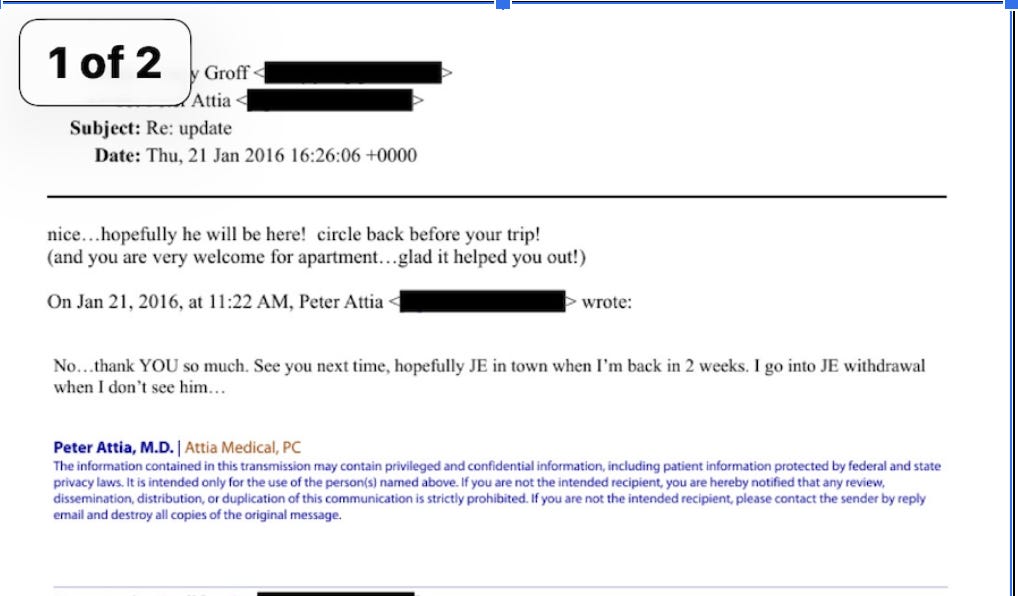
In one email, it is stated that Attia, who we know to be a grown man and a doctor, goes into “JE withdrawal when I don’t get to see him….”
One email in the DOJ files mentions becoming friends with Epstein:
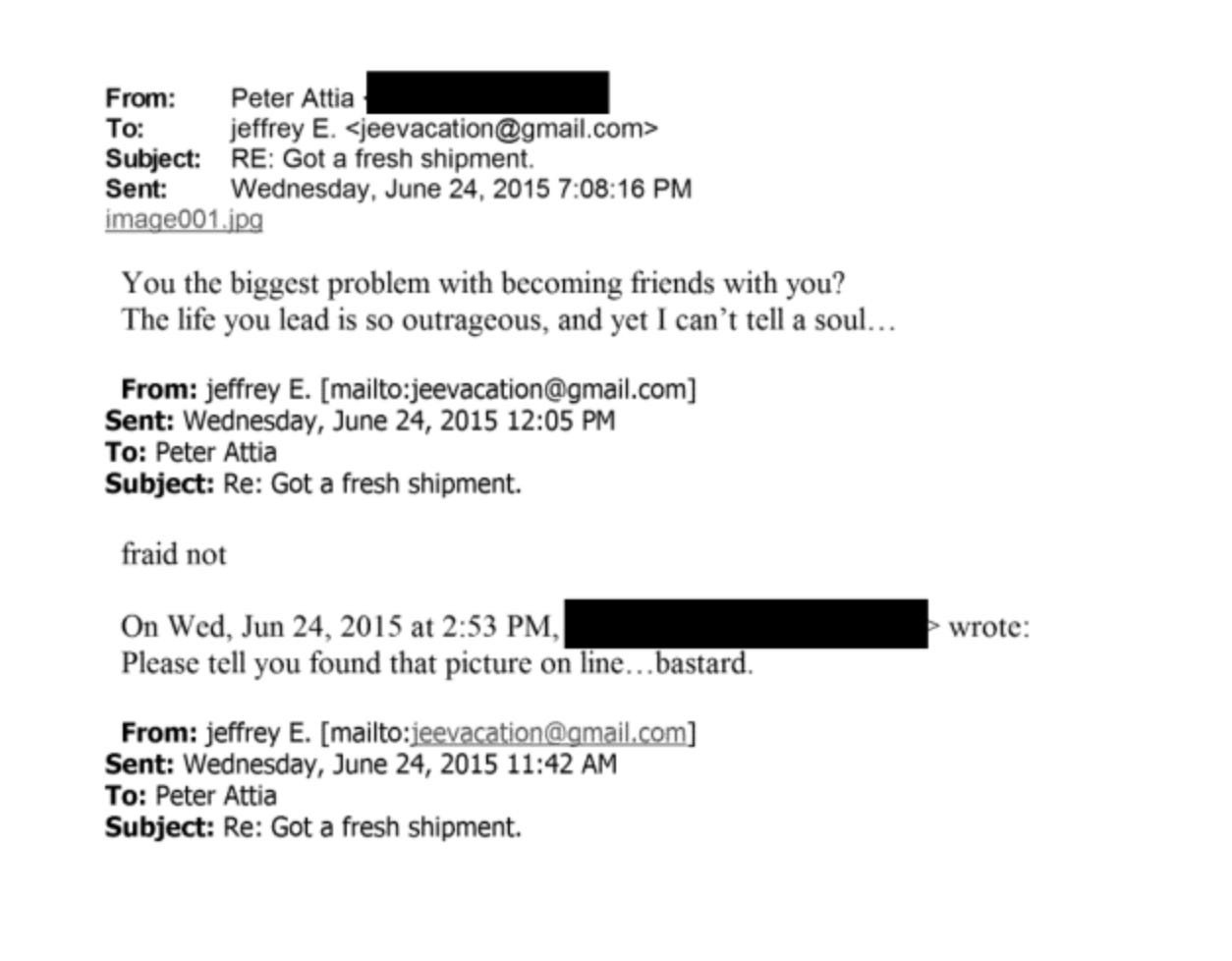
There are redacted images in the email chain and no mention of what the “fresh shipment” mentioned in the subject heading might be.
One email in the DOJ files attributed to Peter Attia references LSJ, likely Epstein’s private island, Little Saint James, and states, “I need to visit sometime…” Here is the email exchange.
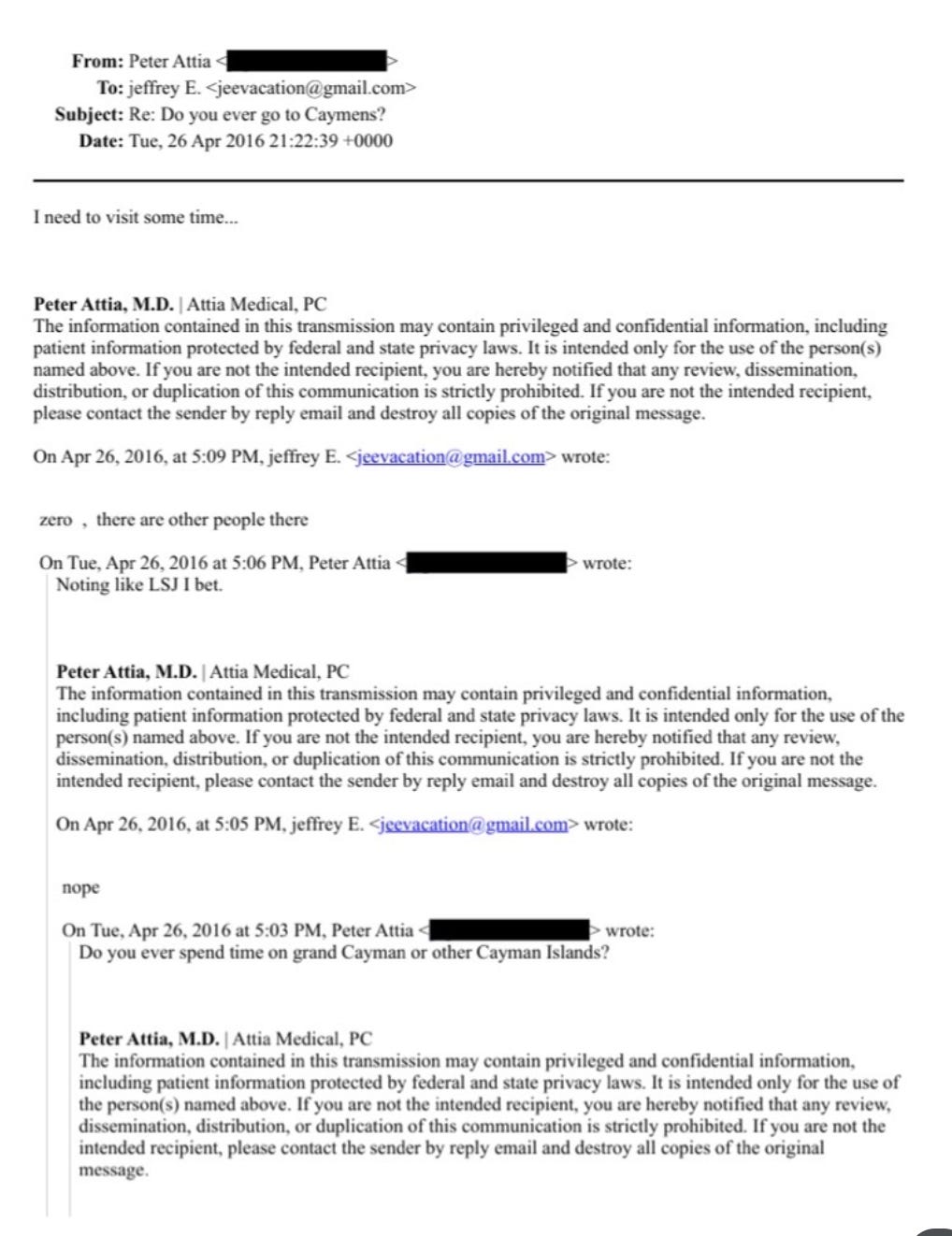
Donald Trump referred to Epstein’s island as a “cesspool” in 2015, although the broader public did not fully connect the island to Epstein’s sexual exploitation network until 2019. Even without what we know now, the idea of visiting the private island of a convicted sexual predator is viscerally repulsive to me.
I have never understood the fascination with Dr. Peter Attia as a medical expert. When I think of medical experts, I want someone who is board-certified by a recognized medical board (for more, read this post) and either produces high-quality research in the field or has extensive clinical expertise or both. Attia did not complete his surgical residency and left in 2006. According to his LinkedIn profile, he then worked at McKinsey & Company as an Engagement Manager from 2006 to 2008 and at Sapphire Energy as Vice President of Business Development and Corporate Strategy from 2008 to 2012, roles that do not help physicians develop medical expertise. His profile says he returned to clinical practice in 2014. The recent 60 Minutes segment states that he sees fewer than 75 patients per year. Not finishing a residency, being out of clinical medicine for eight years, and then running a small concierge practice for the 0.1% is not what I consider extensive clinical experience, but others might feel differently. It does makes me shake my head when I see him quoted about menopause.
I have long had a discomfort with the concept of longevity as a medical speciality. I think it stems from the fact that longevity as a cultural movement has an uncomfortable history of attracting extreme ideas, obscene wealth, and awful people. Early longevity efforts overlapped openly with eugenics, promoting health, vitality, and extended life for those deemed “biologically fit” while ignoring or excluding others. Shorter lifespans for the poor were attributed to “weakness” rather than social and environmental factors, and wealth was seen as a marker of biological or moral superiority. The modern version of longevity also largely ignores well-known factors that shorten lifespan and affect quality of life, such as poverty, violence against women, and environmental hazards, and instead frames longevity as a reward for discipline, which is code for wealth.
When you think about it, community health and public health are the specialties that are truly dealing with longevity, as they are trying to help the greatest number of people with the greatest need. In contrast, modern longevity is the opposite, the pursuit of the individual at all costs. A colonoscopy every year? Sure. Total body MRI? Sign me up. IV peptides? Juice me up. More is better, and don’t I deserve better? Modern longevity clinics seem only too happy to oblige.
Today, the promise of longevity is something that can be purchased, whether it is through overpriced supplements or bespoke high-end concierge programs accessible to the privileged few. It’s no wonder the industry appeals to billionaires and multi-millionaires, as most of them see their fortunes as proof of brilliance rather than being hit by the lucky stick and, often, the exploitation of others.
I get that money and power are appealing, but the sheer number of people who seem to have a connection with Jeffrey Epstein tells me that a lot of people have a high tolerance for ignoring the abuse and degradation of women. I just can’t imagine getting over that to reply to the first email or take the first call.
I think the term longevity medicine has been taken over by influencers, podcasters, and celebrities. But there’s really nothing new about it. Helping people live longer and healthier lives through prevention has always been the core of primary care. Family doctors have been doing this work every day for decades—we just call it primary care, which unfortunately isn’t as catchy.
I hadn’t seen anything about Attia and Epstein yet, so I’m very grateful to you for focusing on this, especially since I live in Austin where Attia is deified by many. In fact, the wellness clinic building where I teach classical Pilates is changing its name to Austin Longevity Clinic, a change that I believe is a direct influence of Attia on the owners of the building. I had an icky but sometimes ambivalent feeling about Attia before—now I am absolutely repulsed. (To be clear, I work in the building but am an independent contractor at a studio that rents space there.)